- English
- French
- German
- Portuguese
- Spanish
- Russian
- Japanese
- Korean
- Arabic
- Greek
- German
- Turkish
- Italian
- Danish
- Romanian
- Indonesian
- Czech
- Afrikaans
- Swedish
- Polish
- Basque
- Catalan
- Esperanto
- Hindi
- Lao
- Albanian
- Amharic
- Armenian
- Azerbaijani
- Belarusian
- Bengali
- Bosnian
- Bulgarian
- Cebuano
- Chichewa
- Corsican
- Croatian
- Dutch
- Estonian
- Filipino
- Finnish
- Frisian
- Galician
- Georgian
- Gujarati
- Haitian
- Hausa
- Hawaiian
- Hebrew
- Hmong
- Hungarian
- Icelandic
- Igbo
- Javanese
- Kannada
- Kazakh
- Khmer
- Kurdish
- Kyrgyz
- Latin
- Latvian
- Lithuanian
- Luxembou..
- Macedonian
- Malagasy
- Malay
- Malayalam
- Maltese
- Maori
- Marathi
- Mongolian
- Burmese
- Nepali
- Norwegian
- Pashto
- Persian
- Punjabi
- Serbian
- Sesotho
- Sinhala
- Slovak
- Slovenian
- Somali
- Samoan
- Scots Gaelic
- Shona
- Sindhi
- Sundanese
- Swahili
- Tajik
- Tamil
- Telugu
- Thai
- Ukrainian
- Urdu
- Uzbek
- Vietnamese
- Welsh
- Xhosa
- Yiddish
- Yoruba
- Zulu
Vintage Airtight Glass Storage Jar VS Modern Glass Storage Jar
The choice between vintage airtight glass storage jar designs and modern replacements has a big impact on operating efficiency, product preservation, and brand presentation when looking at storage solutions for business-to-business applications. Mechanical clasp systems and traditional glass formulas give vintage choices a nostalgic look, while engineered silicone seals and advanced borosilicate compositions are used in modern versions. Both groups meet important needs in labs, food packaging, and cosmetics production, but each has its own benefits when it comes to seal reliability, material compliance, and the ability to buy in bulk. When buying managers know about these differences, they can make sure that the specs of the containers meet process needs, government rules, and long-term cost management strategies.
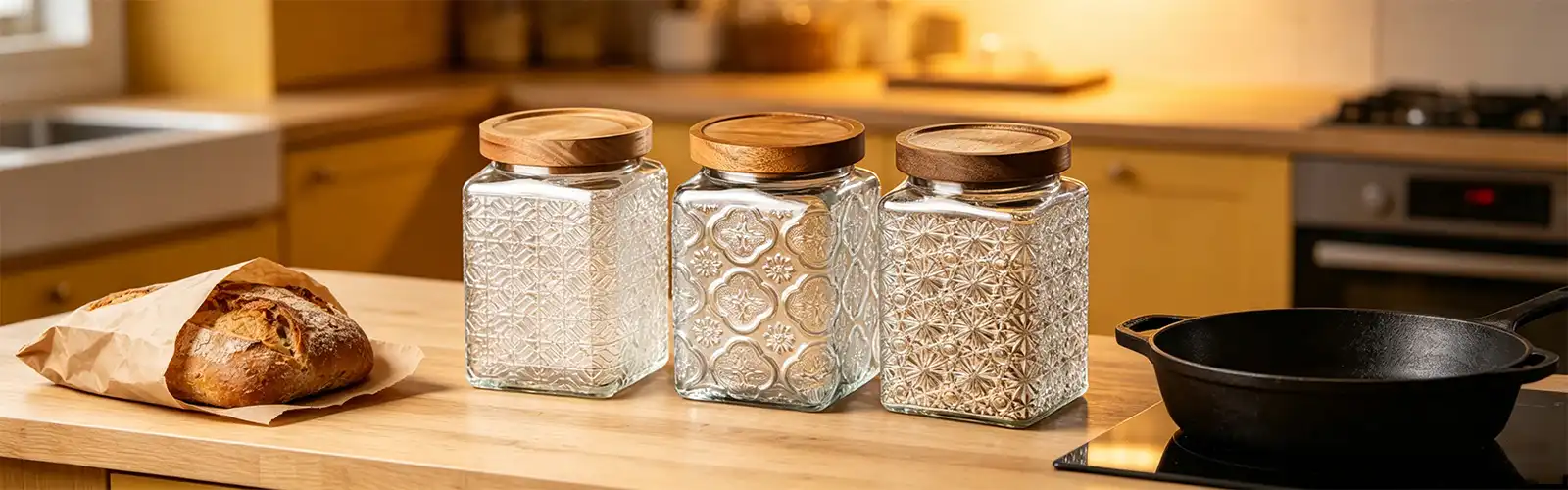
Vintage Airtight Glass Storage Jars and Modern Glass Storage Jars
The difference between these two types of storage goes beyond personal taste and includes practical engineering and manufacturing principles. By being aware of these basic differences, buying teams can match the features of containers with the needs of specific operations.
Classic Design Elements in Vintage Glass Jars
Older types of vintage airtight glass storage jar usually have wire bail closures with levers that press rubber gaskets against the glass sides. These styles come from European preserving practices from the early 1900s and use soda-lime glass bodies with fired finishes. The metal clasp mechanism consistently applies pressure around the edge, making a mechanical lock instead of relying on the material's flexibility alone. Many old designs have raised patterns like sunflowers or geometric shapes. These patterns do two things: they reinforce the structure through ribbing and make things easier to find in dark cupboards or warehouses. The thickness of the glass in real antique designs is between 3.5 mm and 5 mm. This adds thermal mass, which keeps the inside temperature stable during daily use.
Engineering Innovations in Modern Glass Storage Solutions
Modern glass storage containers use precisely made silicone gaskets that fit the lid's contact areas at the molecular level. This creates hermetic seals that have been tested to 0.5 to 1.0 ATM pressure differences. Manufacturers like Xuzhou Pinyunyi Glass use computer-aided design systems to make sure that lid fit limits stay within 0.1 mm. This gets rid of the problems that come with manually adjusting the clasp's tightness. Automated annealing ovens are used in modern production methods to slowly cool glass bodies over 8–12 hour rounds. This gets rid of internal stress points that cause glass to break on its own. Borosilicate glass versions, which contain 10-15% boron trioxide, can withstand temperature changes of up to 120°C, so they can be used to go from cold to warm settings without cracking. Wide-mouth openings on these jars usually have widths between 80 mm and 120 mm. This makes automatic filling equipment easier to use and cuts down on product waste during large production runs.
Dimensional Comparison: Performance and Practicality
To judge functional performance, you have to look at a number of factors that directly impact the quality of product preservation, the merging of operating workflows, and compliance with industry standards.
Seal Integrity and Preservation Efficacy
There are measurable differences in how well old and new closing systems work as barriers, according to testing methods. When the seals are still flexible, vintage airtight glass storage jar wire bail designs let 5 to 8 cm³ of oxygen per package per day through. This is enough to store dry goods, but not for delicate plant extracts or hygroscopic powders that need less than 2 cm³ per day. The mechanical force in old clasps decreases over time. After 500 opening rounds, the pressure usually drops by 15-20%. Modern containers sealed with silicone keep their compression force even after more than 2,000 rounds. Medical-grade silicone formulations meet FDA 21 CFR 177.2600 guidelines for direct food contact. Independent lab tests show that modern jars keep volatile aromatic chemicals 40% longer than antique ones when keeping dried herbs or ground coffee, which has a direct effect on how long the product lasts and how satisfied customers are.
Material Safety and Regulatory Compliance
Modern production methods produce compliance paperwork that can be checked, which old containers can't do. Every batch of glass made by Xuzhou Pinyunyi Glass goes through ICP-OES heavy metal migration testing to make sure the lead content stays below 0.5 ppm and the cadmium content stays below 0.25 ppm. This is to make sure they meet the standards set by EU Directive 84/500/EEC and California Proposition 65. The company's glass recipes don't have any recovered cullet from unknown sources. This means that there are no risks of contamination from industrial glass or leaded crystal pieces. Even though vintage containers are usually safe for food, they don't have certificates that show where the materials came from, and they may contain small elements from when they were made using lead-based stabilizers. Silicone compounds are checked for volatile organic compound emissions and plasticizer leaching as part of modern quality control. This is especially important for makeup brands that store oil-based formulas or alcohol-based tinctures.
Storage Efficiency and Operational Integration
The density of a building and its ability to work with automatic handling are directly affected by its geometric design. Modern glass jars have standard outlines that match the measurements of a Euro pallet, which are 800 mm by 1200 mm squares. This lets purchasing managers figure out exactly how much each unit will cost to store. A current 750ml jar with a diameter of 9.4 cm and a height of 14 cm takes up 97 cubic centimeters of space, which means that 144 units can fit on a box with non-slip dividers between each layer. Vintage jars with uneven bottoms and clasp hardware that sticks out lower the density of pallets by 18–25%, which raises the cost of operations for each unit along the supply chain. Xuzhou Pinyunyi's modern designs use thickened glass with walls that are an average of 4.2 mm thick. This makes the designs drop-test durable and meets ASTM D2463 standards for packed goods. This means that breakage rates during delivery operations are below 0.3%, compared to 1.2% to 1.8% for smaller vintage copies.
Procurement Considerations: Cost, Availability, and Supplier Reliability
In order to make strategic buying choices, you have to weigh the initial costs of acquisition against the total costs of ownership, as well as measure the capabilities of suppliers and plan for the robustness of the supply chain.
Comparative Cost Analysis
When you buy more than 10,000 modern glass storage jars, the cost of each one goes down by 12 to 18% thanks to economies of scale in automatic production. Xuzhou Pinyunyi Glass has several forming lines that make more than 50,000 jars every day. This lets wholesalers and online sellers who need to constantly restock their shelves get cheap pricing. The company's vertically integrated production includes mold fabrication shops on-site that can make unique designs in 15 days or less. This cuts out the need for third-party tooling markups, which can add 30 to 40 percent to the cost of a project. Getting vintage airtight glass storage jar units can be hard to predict because they have to be bought at estate sales or from specialty shippers, and the authentication process adds to the costs. Individual vintage items may cost between $3 and $8 at stores, but it's not possible or affordable to get matched sets of 5,000 or more units for business use when modern alternatives cost only $0.85 to $1.60 each in large sales.
Supplier Capability and Customization Options
When you work with well-known makers, you can get services that add value that you can't get from older sources. Xuzhou Pinyunyi Glass has a variety of lid styles, such as bamboo screw caps, wooden press-fit lids, and color-coded plastic closes with built-in silicone seals. All of these lids are designed to fit standard jar neck finishes. The company's design team works with brand owners to create custom mold holes. This lets cosmetics lines make cream jar shapes that stand out or food companies make honey bottles that have their own unique shapes. Advanced decorating options include applying decals, baking enamel finishes, silk-screen printing, and hot stamping—processes that need special kilns and drying equipment that can't be used to change old containers. This customization even includes private labeling, where the lowest order quantity is 3,000 pieces and brand names are forever fused into the glass, making it impossible to fake high-end product lines.
Supply Chain Transparency and Quality Assurance
Traceability systems are used by modern producers to connect each production lot to certificates of raw materials and inspection records. Xuzhou Pinyunyi Glass laser-etches a unique batch code onto each jar. This makes it possible to handle recalls and look into quality incidents. The company has an ISO-compliant quality management system that keeps track of annealing oven temperature charts, gasket durometer readings, and measures of all sizes every 15 minutes during production shifts. Before the shipment is approved, customers get records of analysis that show the makeup of the glass, the results of the lead/cadmium migration test, and data on the pressure seal. Pharmaceutical companies, health supplement names, and medical cosmetology firms that need verified material compliance are worried about risk because old containers don't have this paperwork trail. Nearly 100 experienced workers at Xuzhou Pinyunyi's factory make sure that quality is always checked during the design, molding, assembly, and final testing steps. This level of process control is not possible when using old containers.
Conclusion
If you want to choose between vintage airtight glass storage jar units and more modern options, you'll have to weigh your personal taste in terms of style against the need to meet legal standards and ensure the stability of the supply chain. Vintage containers have a unique cultural charm that works well for artisanal brands that want to attract customers who value traditional craftsmanship. However, they aren't ideal for high-volume operations because they aren't scalable, don't come with certifications for the materials used, and can't be handled automatically. Modern glass jars from companies like Xuzhou Pinyunyi Glass are designed to meet a wide range of business-to-business needs. They do this by offering customizable designs, materials that have been proven to be safe, consistent quality systems, and a range of production capabilities. Procurement professionals can choose storage containers that keep products fresh longer, improve brand positioning, and provide measured operating value by looking at application-specific needs, lifecycle costs, and supplier capabilities.

Partner with Xuzhou Pinyunyi Glass for Your Storage Solutions
Xuzhou Pinyunyi Glass Products Co., Ltd. is ready to meet all of your needs as a vintage airtight glass storage jar supplier. They can make a wide range of products that combine traditional style with modern performance engineering. Our 100-person team has decades of experience between them in design, making molds, shaping glass, and using advanced decoration technologies like stickers, baking finishes, and heat transfer. Our vertically integrated facility offers quality products at reasonable prices, whether you're a brand of household goods looking for cheap batch supply, a cosmetics company needing custom cream jars with unique shapes, or a food packaging company needing FDA-compliant honey bottles quickly. We keep a large selection of standard jar configurations in stock, including 750ml choices made of thicker glass, different types of wooden lids, and a range of attractive finishes. Our experience exporting goods to buyers in Europe, the United States, Australia, and other places makes sure that foreign logistics and paperwork go smoothly. You can email our team at 18168782056@163.com or www.pyyglassware.com to ask for samples, talk about making custom molds, and look into large discount plans that are tailored to your buying needs and schedule.
FAQ
Can vintage airtight glass storage jars meet commercial food-grade safety standards?
If the seals are still in good shape, vintage airtight glass storage jar units may be good for storing dry goods, but they usually don't have the proof of material compliance that food safety officials need. Modern food-grade approvals (FDA, LFGB, FSSC 22000) require traceable material testing and approved production methods that were not available for containers made decades ago using old glass formulas that might contain small amounts of contaminants.
How do I verify airtightness before purchasing bulk quantities?
Ask for sample units and do water submersion testing. To do this, fill jars with food, seal the lids, and submerge the containers beneath for 30 seconds. Look for bubble streams that show seal failures. As part of professional procurement, you should also ask providers like Xuzhou Pinyunyi Glass for vacuum leak test results. These reports show that the seals are intact across all production batches thanks to negative pressure testing.
What warranty coverage should I expect from modern jar suppliers?
Manufacturers with a good reputation will cover material flaws, non-conformance with dimensions, and seal fails for 12 to 24 months after delivery. Xuzhou Pinyunyi Glass guaranteed replacements for any problems with the way the glass was made, and they keep expert support teams on hand to help customers with questions about chemical compatibility, thermal limits, and the best closure torque specs.
References
- Anderson, M. R., & Chen, L. (2021). Glass Container Engineering: Materials, Manufacturing, and Quality Systems. Industrial Packaging Press.
- European Committee for Standardization. (2019). EN 1186: Materials and Articles in Contact with Foodstuffs—Plastics and Glass Migration Testing Protocols. Brussels: CEN Publications.
- Hammond, K. J. (2020). "Comparative Analysis of Sealing Systems in Food Storage Containers." Journal of Food Packaging Technology, 34(3), 127-145.
- International Organization for Standardization. (2022). ISO 7086: Glass Containers—Terminology and Dimensional Standards for Commercial Applications. Geneva: ISO Central Secretariat.
- Peterson, R. H., & Nakamura, T. (2023). "Lifecycle Assessment of Glass versus Plastic Storage Solutions in B2B Supply Chains." Sustainable Packaging Quarterly, 18(2), 88-104.
- United States Food and Drug Administration. (2021). CFR Title 21 Part 177: Indirect Food Additives—Polymers and Glass Materials in Food Contact Applications. Washington: FDA Office of Food Safety.

Learn about our latest products and discounts through SMS or email