- English
- French
- German
- Portuguese
- Spanish
- Russian
- Japanese
- Korean
- Arabic
- Greek
- German
- Turkish
- Italian
- Danish
- Romanian
- Indonesian
- Czech
- Afrikaans
- Swedish
- Polish
- Basque
- Catalan
- Esperanto
- Hindi
- Lao
- Albanian
- Amharic
- Armenian
- Azerbaijani
- Belarusian
- Bengali
- Bosnian
- Bulgarian
- Cebuano
- Chichewa
- Corsican
- Croatian
- Dutch
- Estonian
- Filipino
- Finnish
- Frisian
- Galician
- Georgian
- Gujarati
- Haitian
- Hausa
- Hawaiian
- Hebrew
- Hmong
- Hungarian
- Icelandic
- Igbo
- Javanese
- Kannada
- Kazakh
- Khmer
- Kurdish
- Kyrgyz
- Latin
- Latvian
- Lithuanian
- Luxembou..
- Macedonian
- Malagasy
- Malay
- Malayalam
- Maltese
- Maori
- Marathi
- Mongolian
- Burmese
- Nepali
- Norwegian
- Pashto
- Persian
- Punjabi
- Serbian
- Sesotho
- Sinhala
- Slovak
- Slovenian
- Somali
- Samoan
- Scots Gaelic
- Shona
- Sindhi
- Sundanese
- Swahili
- Tajik
- Tamil
- Telugu
- Thai
- Ukrainian
- Urdu
- Uzbek
- Vietnamese
- Welsh
- Xhosa
- Yiddish
- Yoruba
- Zulu
Honeycomb Shaped Glass Honey Bottle For Decorative Display
A honeycomb shaped glass honey bottle is a premium food-grade glass container distinguished by its hexagonal geometric tessellation that replicates the natural architecture of beehive cells. This specialized round packaging vessel features high-quality white glass with a 5mm thickness, available in white and transparent color options that maximize honey's visual appeal. The textured design offers more than aesthetic value—it provides structural reinforcement through its geometric pattern, reducing side-wall vulnerability during stacking and transport while enabling premium honey brands to command higher price points through enhanced shelf presence and tactile branding.
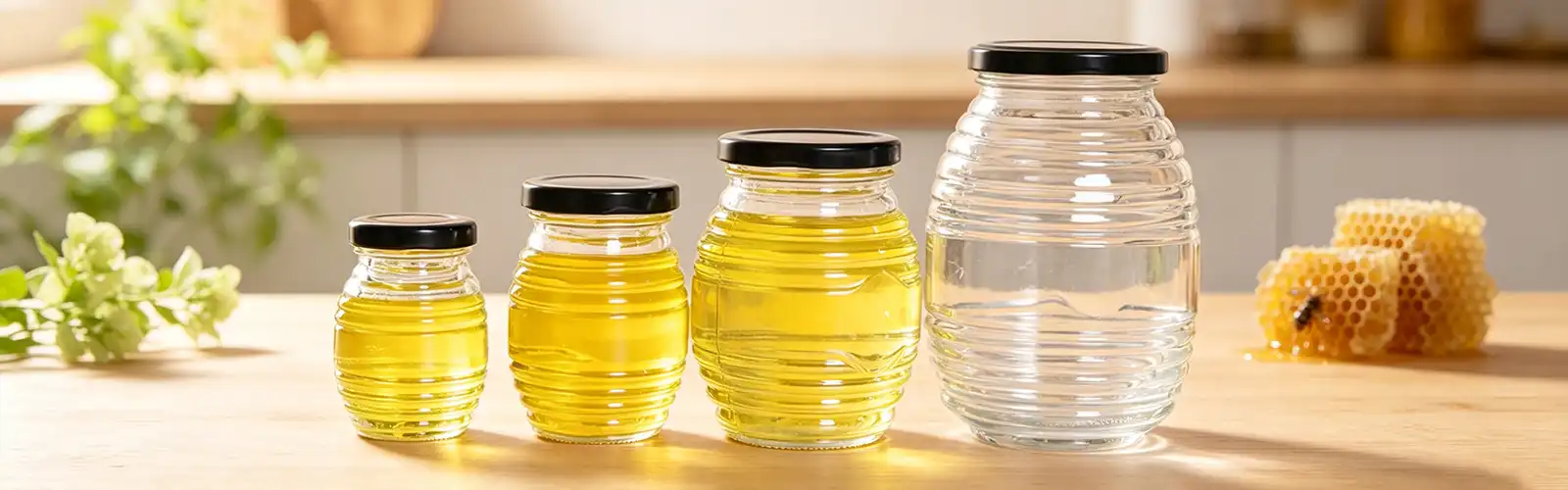
Honeycomb Shaped Glass Honey Bottles
Origins and Design Philosophy
These unique jars have a hexagonal pattern that comes from centuries-old farming customs that praised the perfect geometry of natural honeycomb structures. What started out as handiwork by artisans has grown into complex industrial production, where precise shaping techniques make these natural designs very consistently.
Technical Characteristics That Matter
Modern honeycomb shaped glass honey bottle units are made from high-flint soda-lime glass, which is a type of high-quality white glass that is very clear and good at reflecting light. The round form of the bottle keeps it compatible with normal filling equipment, and the textured outside gives the bottle more depth by reflecting light. With this mix, a simple container is turned into a high-end show piece that stands out on store shelves.
The 5mm wall thickness gives it great sturdiness without making it too heavy, which is good for both shipping security and easy handling. Because honey comes in both white and clear, brands can choose to show off its natural golden colors or make unique frosted presents.
These bottles usually have thermal shock resistance differentials of at least 42°C, which keeps them stable during the hot filling steps that are common in honey production. This standard keeps honey from cracking when it is handled at high temperatures to prevent it from crystallizing too soon. The chemically neutral, non-porous glass meets FDA and EU 10/2011 food contact safety standards. This means that dangerous substances will not leak into organic honey products.
Functional Advantages for Brand Differentiation
The honeycomb design is textured and has more than one practical use besides decoration. The raised hexagonal cells act as supporting plates that make the jars more resistant to impact than jars with smooth walls of the same weight. This geometric structure better spreads force during drop tests, which lowers the rate of breakage during shipping operations.
The form naturally bends and catches light, making interesting visual effects that people want to look at. This visual quality is especially useful in places like farmers' markets, specialty food stores, and gift shops where the way a product looks directly affects people's decisions to buy it. When you touch these textured bottles, you create remembered brand interactions that support premium placement and make up for higher retail prices.
Comparing Honeycomb Glass Honey Bottles with Other Packaging Options
Glass Versus Plastic: Material Performance Analysis
Plastic honey bottles are most popular with people who are trying to save money, but they make it hard for brands that want to appeal to people who care about quality. Glass cases keep honey's flavor profile without changing the taste or letting chemicals move around. Honey has a naturally sour pH that can react with some plastics over long periods of storing, which could damage the product.
Consumer study shows over and over that glass packing always means quality and authenticity. When people take blind taste tests, they rate similar honey products higher when they know the honey came from glass cases instead of plastic squeeze bottles. This difference in how people see things directly affects buying power—honey in fine glass usually sells for 30–50% more than honey in plastic bottles.
Environmental factors are becoming more and more important in B2B purchasing decisions. Glass can be recycled over and over again without losing any of its quality, which meets the needs of environmentally conscious shoppers and stores. Because the honeycomb shaped glass honey bottle design is durable, it can be used again and again. Customers can return empty bottles to be refilled, which creates chances for the circular economy that build brand trust and lower long-term packing costs.
Smooth Glass Versus Textured Honeycomb Designs
Standard cylinder smooth glass jars work well and are reasonably priced, but they don't look very different from one another. When store shelves are full of packages that look alike, price becomes the main thing that sets them apart. This pattern is broken by the honeycomb structure, which stands out right away.
The curved shape of the bumpy surface makes the structure stronger. Independent tests show that these strengthened walls can handle vertical compression loads of more than 200kg. This is important for palletized shipping because the bottom-layer containers carry a lot of weight. This strength edge cuts down on damage claims and the costs of replacements that come with them.
Labeling does depend on the roughness of the surface. Some good makers fix this problem by adding "flat windows" that are smooth. These are round or rectangular areas where the honeycomb pattern is not present. These areas have perfect surfaces for labels to stick to, making sure the bottle looks professional while keeping its unique look on the other surfaces.
Practical Buying and Procurement Guide for Honeycomb Shaped Glass Bottles
Capacity Selection and Volume Considerations
The honeycomb shaped glass honey bottle can hold anywhere from 200ml to 1000ml, so they can be used for a variety of market placement tactics. Smaller sizes (200–300ml) are good for gift sets and trial programs, while 500–750ml sizes are good for everyday store purchases. Larger 1000ml sizes are good for people who buy in bulk and for food service.
The choice of volume should be based on how the target customer acts and where the price is set. According to market research, most American families prefer normal use 500ml honey containers because they are easy to store and make buying honey more frequent. Specialty breed honeys are sold in smaller 250ml bottles that make them seem more exclusive and command higher prices.
Glass Quality and Safety Certifications
High-quality white glass meets strict safety standards and makes sure that the honey looks its best. Type III soda-lime glass is chemically resistant and stable at high temperatures, making it perfect for use in food contact situations. Specifications for purchases should include checks for compliance using FDA rules for food contact substances and appropriate ASTM testing methods.
Wall width consistency is very important. Using ultrasonic measurements for quality control makes sure that the honeycomb depressions don't make any thin spots smaller than 1.5mm that could break when pressure is applied. Using polarized light to check the quality of the annealing process makes sure that the stress is spread out evenly across the complex geometric design. This keeps the metal from breaking on its own while it is being stored or transported.
Customization Capabilities and Brand Integration
Leading makers allow for a lot of flexibility, which helps brands stand out. By pressing a logo directly into the glass while it is being molded, a lasting mark is made that can be washed and used again. Surface treatments like frosting, spray painting, and applying decals make it possible for unique visual shows that are in line with brand names.
Closure choices have a big effect on how things work and look. Gold-coated tinplate lug caps with plastisol liners make vacuum seals that keep honey from fermenting and crystallizing. Thread compatibility is important. For high-volume processes, 58mm and 63mm lug ends are industry standards that make sure they work with automatic capping equipment.
With private labeling, distributors and stores can make their own honey lines without having to spend money on making bottles. For special orders, the minimum order quantity varies by provider and can be anywhere from 10,000 to 50,000 units. Stock bottle designs can often handle smaller first orders, which lets you test the market before making bigger promises.
Supplier Evaluation and Partnership Considerations
When screening possible suppliers, you need to look at their production skills, quality control systems, and contact systems. ISO 9001 certification shows that quality control systems are in place, and food-grade standards show that you understand how to follow the rules.
Delivery times and the power to grow are affected by production capabilities. When a manufacturer has more than one production line, they can handle large orders and changes in seasonal demand without affecting delivery times. For stock setups, lead times are usually between 30 and 45 days. For special mold development, they can be anywhere from 60 to 90 days.
To be competitive with prices, you need to find a mix between quality guarantee and cost. Very low prices usually mean that the quality of the glass isn't good, the sizes aren't uniform, or there isn't enough quality control. When you ask for samples before you place a large order, you can directly see how clear the glass is, how well the patterns fit, and how strong the structure is.
Conclusion
The honeycomb shaped glass honey bottle represents a smart investment in packing for B2B buyers who want to stand out in quality-focused market segments. The mix of strong structure, high-end looks, and eco-friendliness meets important needs in the home goods, food packaging, gift, and specialty store industries. The 5mm thick, high-quality white glass construction makes it long-lasting, and the unique geometric design makes an instant visual impact that supports premium placement. As more and more people choose eco-friendly and eye-catching packaging, these new containers offer procurement managers tried-and-true ways to balance usefulness, brand identity, and environmental responsibility. Because it can be used for many different things, from making handmade honey to selling gifts, it can support a variety of business models. It can also be reused, which is something that big stores are starting to ask for more and more.
Partner with Xuzhou Pinyunyi Glass for Premium Honeycomb Bottle Solutions
Your honeycomb shaped glass honey bottle needs are met by Xuzhou Pinyunyi Glass's nearly 100 creative workers and cutting-edge production facilities. Our factory specializes in making food-grade glass containers that meet international safety standards. You can customize a lot of these containers to help your brand stand out. We have reasonable prices for large orders, and our minimum amounts are flexible so that we can test the market before committing to large-scale production.
Our full service includes designing molds, making them, checking the quality, and coordinating operations for honeycomb shaped glass honey bottle manufacturers. The technical team gives advice on choosing the right size, making sure the closing works with the container, and adding artistic touches like decals, painting, and heat transfer that make the container look better. Products are carefully checked for quality by measuring the thickness of the walls, inspecting them after heating, and putting them through load tests. This makes sure that the containers meet strict shipping and storing requirements.
We accept requests from companies that make household goods, package food, sell gifts, and do business internationally and are looking for trusted honeycomb shaped glass honey bottle suppliers. You can email us at 18168782056@163.com to get samples, talk about custom requirements, and find out how our glass packaging options can help your honey goods do better in the tough American market.

FAQs
Does the Textured Surface Complicate Labeling?
Professional honeycomb shaped glass honey bottle units have smooth "flat windows"—areas where the pattern isn't there—so that labels can be put on them. Standard pressure-sensitive stickers will stick perfectly to these places. The leftover textured surfaces keep things looking different, and marking zones that are useful for branding, nutritional information, and meeting legal requirements don't suffer any losses.
Can These Bottles Handle Hot-Fill Processing?
The bottles are made so that they can be filled with hot liquid at temperatures between 60°C and 85°C, which is normal for making honey. Cracking doesn't happen during filling processes because the thermal shock resistance difference is higher than 42°C. This standard lets honey makers fill at high temperatures that lower viscosity, which improves flow and filling speed while keeping the integrity of the product while it cools.
How Do Honeycomb Bottles Compare in Shipping Durability?
The hexagonal design on the surface acts as structural support, spreading contact forces more evenly than smooth walls. Drop tests show that they are more resistant to breaking than smooth bottles of the same weight. The geometric lines increase the vertical load capacity, which helps palletized shipping where heavy packages are placed on the bottom. Using corrugated dividers in the right way when packing keeps damage to a minimum while traveling through domestic and foreign transportation networks.
References
- Specialty Food Association. "2023 State of the Specialty Food Industry Report: Packaging Trends and Consumer Preferences." Specialty Food Association Annual Market Research Publication, 2023.
- National Honey Board. "Honey Packaging and Presentation: Impact on Consumer Purchasing Decisions." National Honey Board Industry Research Series, 2022.
- Glass Packaging Institute. "Life Cycle Assessment of Glass Container Production and Reuse Systems." Environmental Impact Studies in Packaging Materials, 2023.
- American Society for Testing and Materials. "ASTM C1279: Standard Test Method for Thermal Shock Resistance of Glass Containers." ASTM International Standards for Glass Testing, 2021.
- Food and Drug Administration. "CFR Title 21: Food Contact Substances and Generally Recognized as Safe Determinations for Glass Packaging." FDA Regulatory Guidelines for Food Packaging Materials, 2023.
- Institute of Food Technologists. "Advances in Specialty Food Packaging: Geometric Design Influences on Structural Integrity and Consumer Appeal." Journal of Food Science and Technology Packaging Research, Volume 58, 2022.

Learn about our latest products and discounts through SMS or email